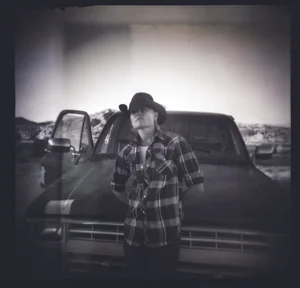

Animals as Individuals: The Work of Artist Jane O’Hara
Animal Culture Magazine
By Patricia Denys and Mary Holmes
February, 2026 Vol 8 Issue 3
Join Animal Culture Magazine on Patreon
Animals Across America Traveling Exhibition Learn More
Jane O’Hara Projects
Jane O’Hara, Adopted Herd Acrylic on canvas 26×40”
Jane O’Hara, Breach Acrylic on canvas 40×24”
We recently interviewed artist Jane O’Hara, regarding her current work in process, and her creative process. According to her website, “Jane O’Hara is a contemporary American artist, curator and founder of Jane O’Hara Projects (JOP) 2015. O’Hara received a BFA in painting at Boston University, Boston, MA, and a Curatorial Certification from Sotheby’s Institute of Arts. Using transformational curatorial projects, presentations and publications as a platform, JOP seeks to expand social awareness of speciesism through the arts, and to cultivate compassion for all life; both human and non-human animals.” O’Hara has won multiple awards, and her work has been presented and exhibited throughout the United States.
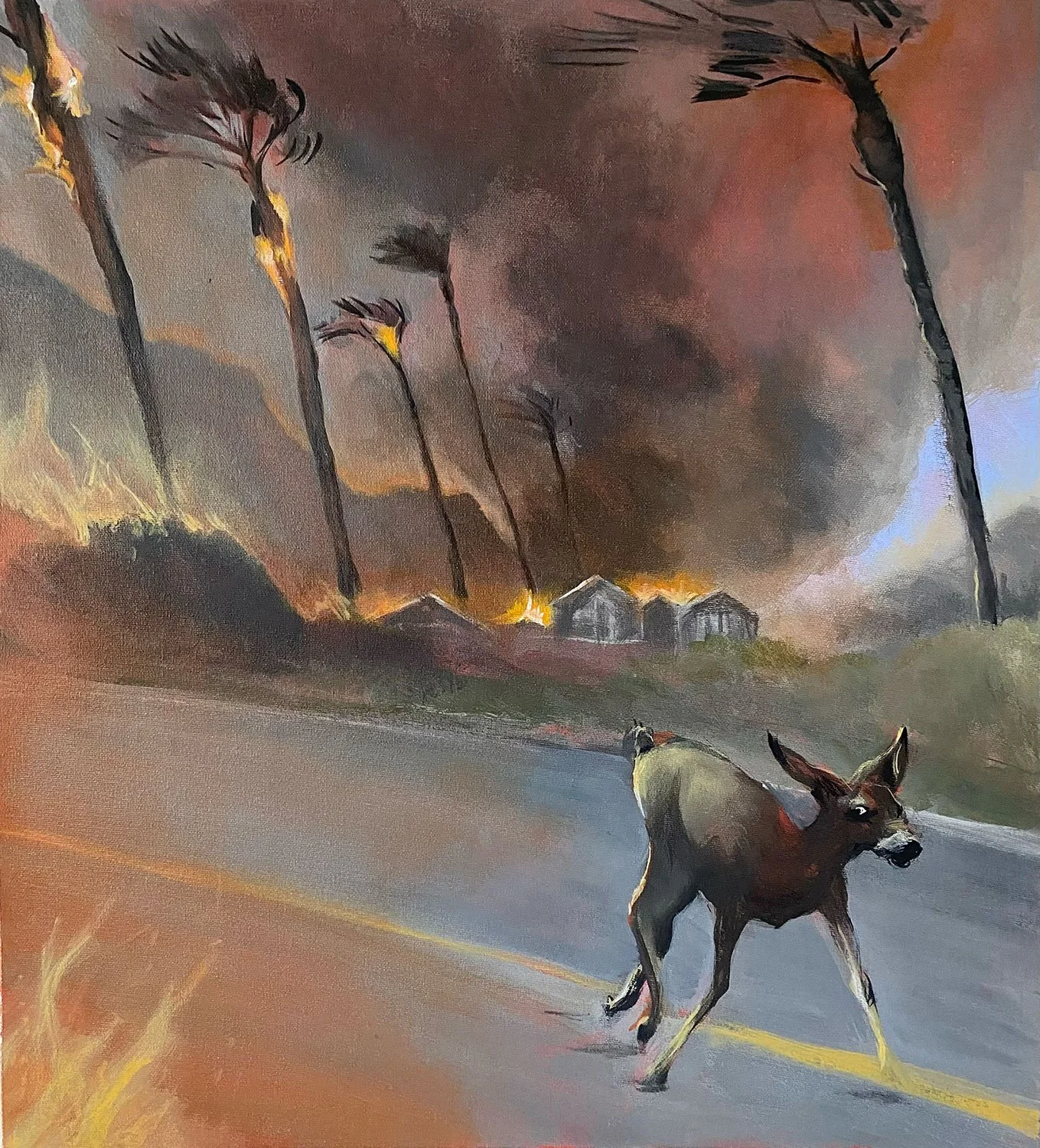
Jane O’Hara, City of Angels, 2025 Acrylic on canvas 21 x 19"
We first talked about her recent body of work, Animal Instinct. “I was thrilled to have my Animal Instinct exhibition at the William-Scott Gallery in Provincetown this July. They’re a great gallery, and they’ve always been very supportive of my work. I’ve been with them for quite a while now. For the theme of Animal Instinct – I was just struck with the idea of animals doing their best to survive in these mostly man-made dilemmas that they find themselves in, or natural disasters that in part are man-made as well. Like my painting, “City of Angels” was inspired sadly by thinking of the animals that were also collateral damage in the fires of Los Angeles, and the deer runs for her life from the flames. And “Breach” is a pig that’s running towards us, and I keep it somewhat obscure, but for me, what inspired this story was a collapsed transport truck of pigs, and this one got away. So, each painting defies or contends with these overbearing forces.”
Asked what inspired her work, State of the Union, O’Hara responded, “In State of the Union, when this idea came to me it’s hard to pinpoint because there are always so many influences, and I kind of work intuitively. But I’m always looking for new creative, ways to try to put into a narrative these vastly conflicting ideas. So in State of the Union, which I’ve now renamed Animals Across America as I plan to travel this exhibition, I started with Florida State of the Union. I’d heard of several awful things in that state – a bear hunt, dolphins in captivity for entertainment which everybody knows, the red tide, which kills manatees and fish, cow abuse at a dairy, and a primate breeding facility. So thinking of all these things, and how they contrast with the sunny fun vacation land image got me thinking of that sort of iconic state postcard for each state has a state animal and this reverence for animals in theory and how that contrasts to these behind the scenes or behind people’s consciousness, what goes on with animals in that state. I did not start it to be a 51-painting series, but, about 4 paintings in where I’ve done some states where I’d had experience, I got into this residency in Colorado, and did 4 more on the concept of it. And then at that point, I presented the idea to the New Bedford Museum of Art, and they wanted to do a show, so three years later that group of paintings was finally finished.”
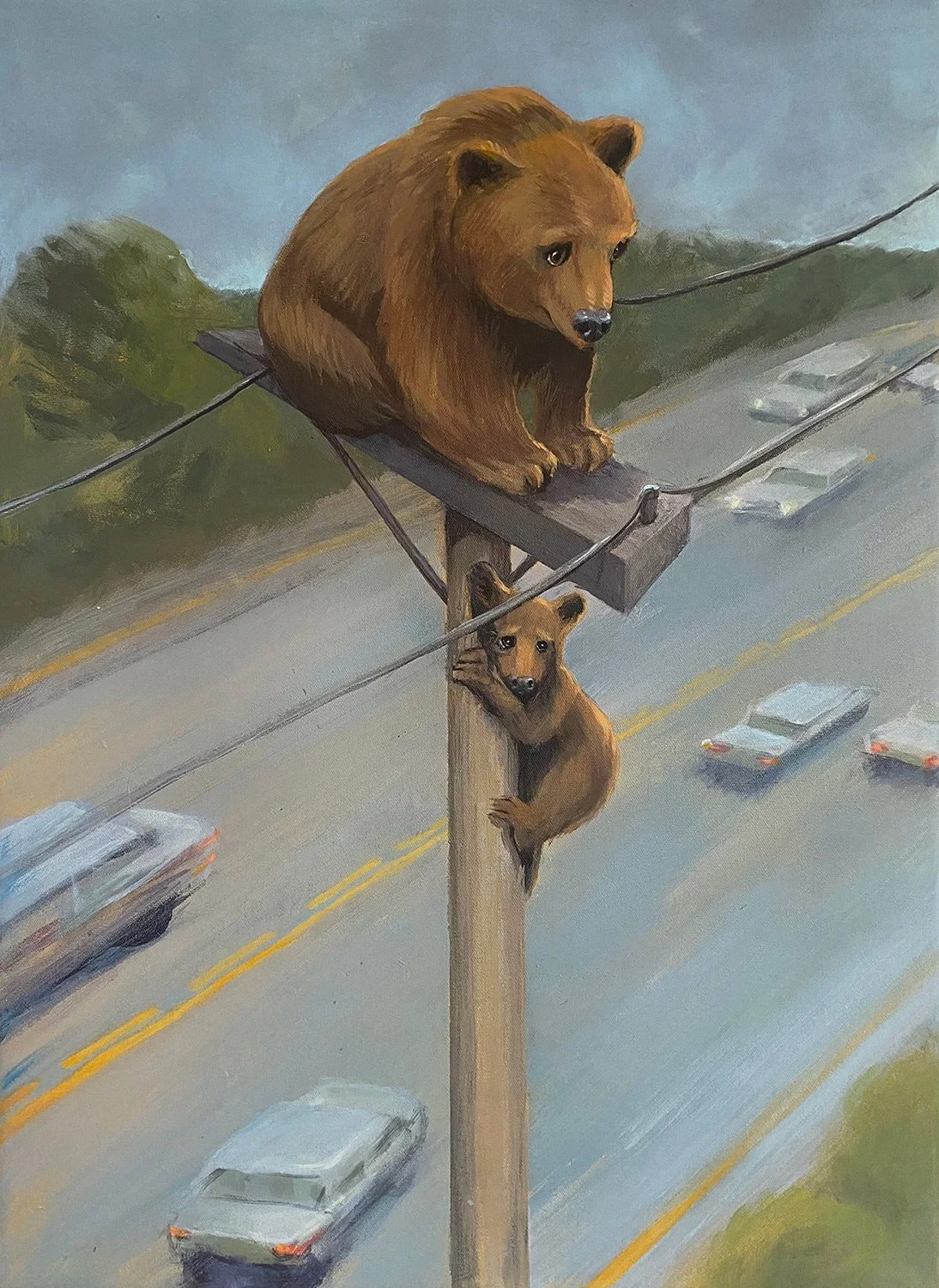
Jane O’Hara, Plan B, 2025, Acrylic on canvas, 30 x 22"
She responded to the question of what drives her as an artist and activist to create the work she does with the following: “I have great empathy for the animals under our stewardship who have no ability on their own to stand up for themselves, to speak out or to rebel. A few select animals have our love and appreciation while millions of others are in danger and imprisoned. So the cognitive dissonance there is disturbing. And I try to make my work express these unequal worlds and our part in them, or our blindness to them and so I just try to find different ways to portray that without… I don’t know. I like to use humor and irony and ways to sort of pierce through people’s disconnect.” She continued with what prompted her to do this work, “Well, it evolved. I first started adding animals to my work over 20 years ago. I’ve been, hadn’t been painting for a while and I started doing landscapes and I realized I was kind of bored with just landscapes, so I started putting animals into them. And meanwhile, I was fighting internally with this growing awareness of what goes on with animals, which eventually resulted in my walking the walk and becoming an ethical vegan. I just wanted to bring this awareness to what we do to animals into my artwork at that point. So it became more and more intentional, but it’s sort of evolved that way with my own growth.”
How is her work received? “I’m always so interested to see the varying reactions to my work. I do use humor and irony in my paintings to convey this message of our complex relationship with animals. So people’s reactions vary wildly. Some turn away, some think it’s kind of playful, and others land in the middle, more what my intention is about it. I just feel that it lands with people sort of where they’re at, but I hope through my portraying the animals in a way that one can connect with them, that it will start to sort of eat away at their blindnesses or their denials. “Reactions really, really vary. People will often tell me what their favorite painting is. Some people will just say, ‘Oh, this is so sad, I almost don’t want to look at it, but you painted it beautifully,’ and other people will just think it’s very powerful. I don’t know. There’s just a real, real wide range. I think our arrangement really represents how people are in this society. There are people who don’t want to think about stuff and then… And being in Provincetown, it’s not a city; it’s a more of a commercial environment. I don’t think people necessarily go into a gallery like that and expect to be thinking about these types of things.”
What does she expect the viewer to leave with? “I’d love the images and the narratives to leave them questioning. Questioning our treatment of animals and maybe their part in it. I try to bring the heart of the animal to the viewer, which hopefully pierces through any apathy that we all fall into. I hope that, and I wouldn’t mind if they left with the painting they bought either.”
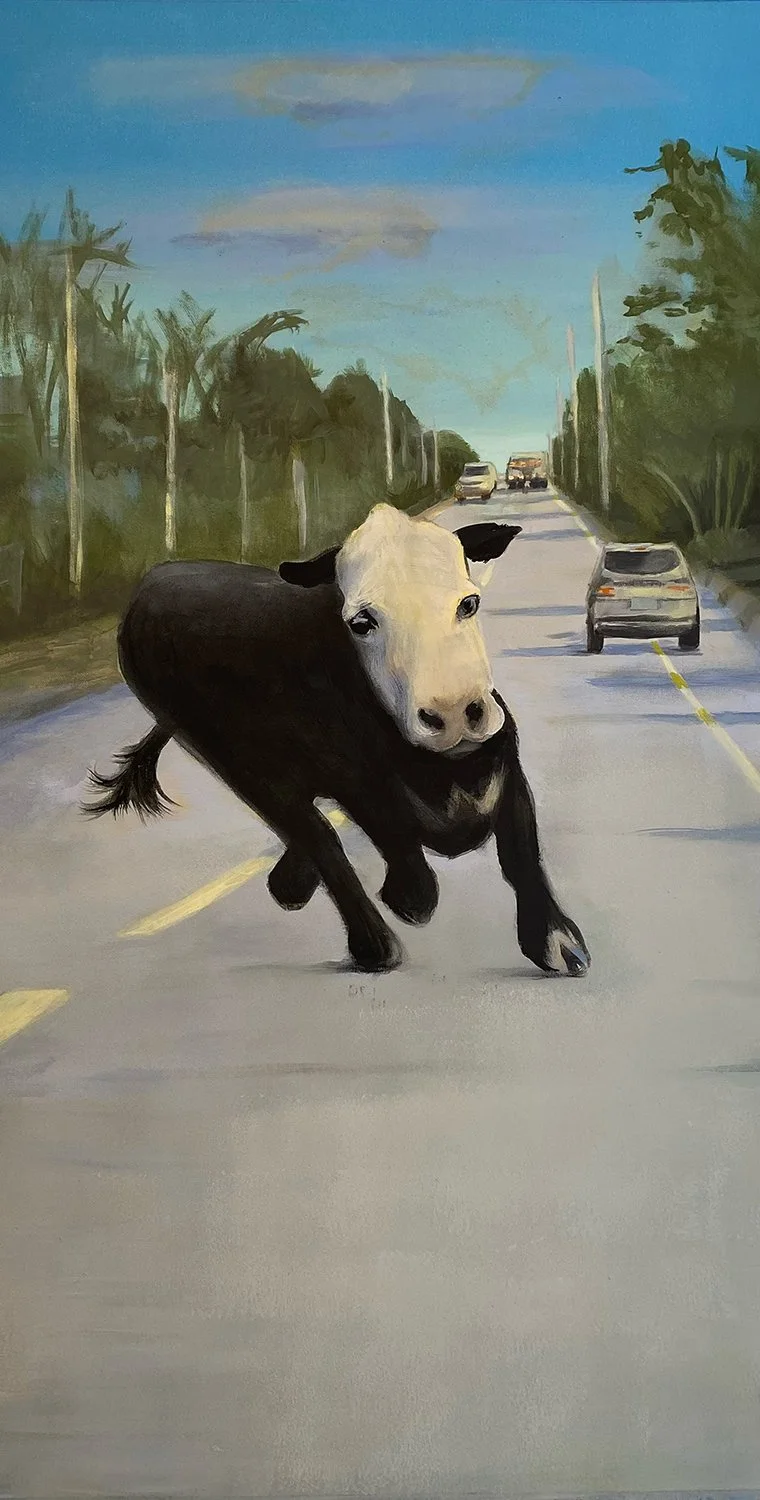
Jane O’Hara, Resistance, 2024 Acrylic on canvas 42 x 22"
We asked her what she believed to be some major topics that we as a society should be focusing on and be proactive about right now. Her immediate response was, “You mean aside from saving our democracy?” She continued, “He plays (Ed. Note: the current president) a part in a lot of this, but they existed before. I just think there’s a number of things like mass consumerism and corporations, and the political divides. They all contribute to a numbness of the individual. My focus is the animal individual, reduced to generic and inhuman terms, like livestock or meat, dairy, entertainment, research. I want to bring awareness to the fact that each and every animal is a sentient being, and suffers the same as our sweet Chihuahuas and kitties would.”
What motivates her to keep working? “I honestly don’t know how much influence I have, or any one of us has, but collectively, I hope and I believe, that the consciousness is growing. I’d like to have my part in that. I’m motivated when I see or hear people changing their lifelong habits because they can no longer close their eyes, and that covers a range of all topics, but in my artwork and about animals, I’ve experienced that with people and I love that.”
O’Hara stated she doesn’t feel she has created one piece of that comes closest to what she is trying to express as an artist and activist. “That’s a hard one, because while my focus is generally the same, I take a different approach with each body of work, and each painting in that body of work. It’s not really a closest, but a general kind of fascination with different perspectives. It’s sort of like being asked who’s your favorite kid? Of course, I don’t have kids, so I don’t know what that’s like. I do love ‘Breach’ from this last series, but I can’t really tell you why. I don’t know if it was more successful or less successful or anything, or if it’s personal. It’s just a hard question to answer, to tell you the truth.”
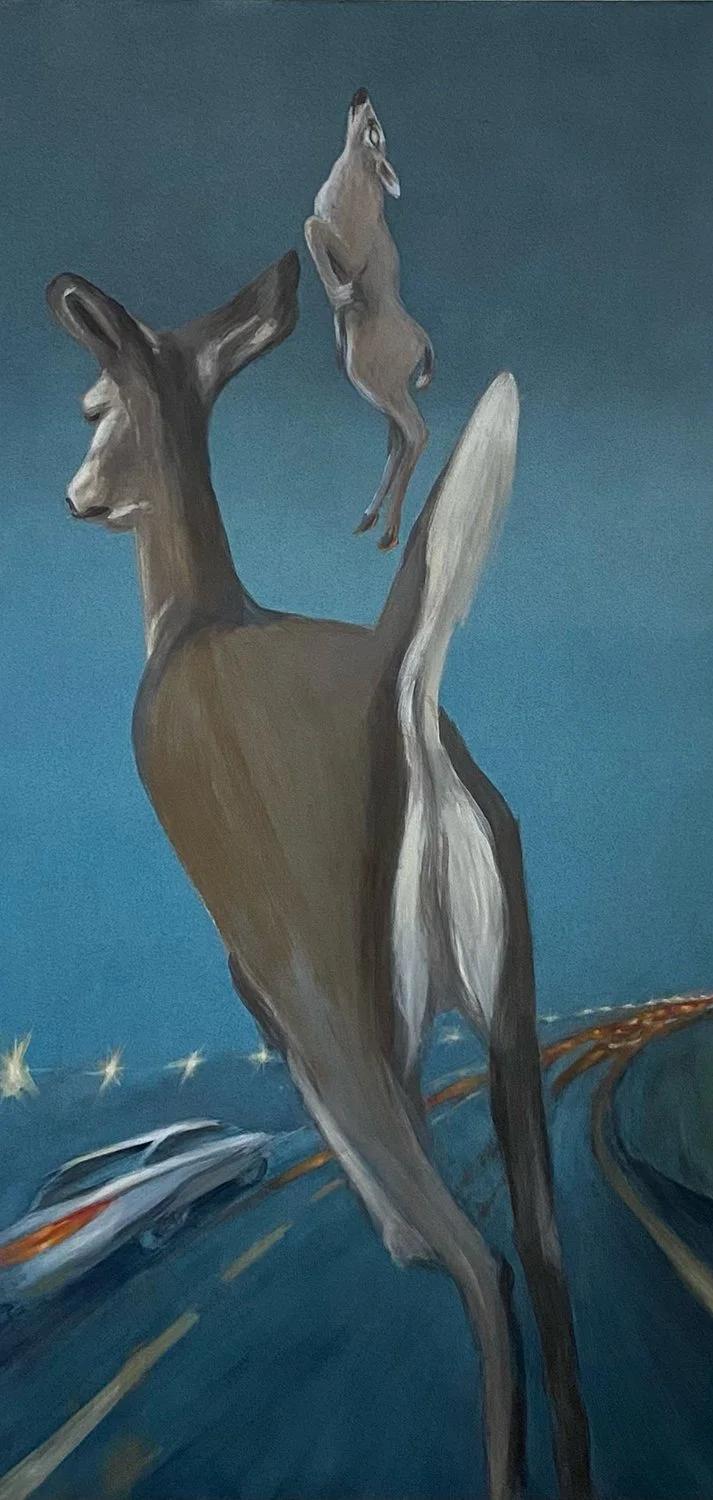
Jane O’Hara, Twilight, 2024 Acrylic on canvas 48 x 24"
Asked if there was an artist or artists whose work really had an impact on her, the answer was surprising. “Not really. I mean, I have so many influences. There’s a lot of different artists that I love for different reasons. I actually don’t have any specific names to give you. I am voraciously always looking at art. I’ve just been in Philadelphia. I’ve been going to many museums. I go to openings and shows and I’m in an art group that, and the other galleries in the William Scott Gallery, all these things. I am influenced by others, but there’s no one, or even a couple of artists, that specifically I hold onto in that way.
When we inquired about her goals for the future, O’Hara’sanswers were much more specific. “Well, I’ve just completed my Animals Across America traveling exhibition website. And my first proposal has been sent out. I was introduced to the director of the Plymouth Center for the Arts in Massachusetts, and I’m very hopeful about showing there. It’s a great space, and a space where I could have all the paintings in one room and not crammed together but nicely spread out. I think that would be exciting. “I’m sort of still not quite sure what the next body of work will be. I’m working on a couple of paintings and, often for me, I do 1,2,3, paintings and then it reveals itself to me where my mind is going. I’ll be working on that as time goes on, and probably have some new work at the William Scott Gallery next season.”
She added, “There’s another vegan artist. I love her work. I was in a show with her in Los Angeles that Karen Fiorito put together. Her name is Melanie Oliva, and she had told me about this gallery in Miami. I’ve sent some work down there, some work that I did before the Animal Instinct. I’m excited about that cause they’re very, very involved with getting a conversation going. And they have this event, where they chose one of my paintings, which is, “Wish You Were Here,” and they have a poet who’s going to write a poem to it. I think that’s really fascinating; there’s a lot of energy at the gallery to kind of bring the conversation going. They’re very message-driven paintings. So, that’s exciting too. That’s definitely a goal to get new galleries and find various venues and ways to get my work out there.”
When asked if there was anything else she like to share with our readers, her response was, “You know, I didn’t really think about this question that much. I don’t know, you’re probably gathering by now, but a lot of my process, a lot of the way I work is fairly intuitively, and while there are always goals kind of forming in the corners of my subconscious, I’m not really driven by a way of answering that. I don’t know.
What I’d like them to know is to go to my website where I have put the time into talking about the different aspects of my journey and what I’m trying to do. But other than that, I just want people to have access. I mean, that’s the worst fear of any artist, is just to be painting into a vacuum, or into a closet. “I was just thrilled about the interview because in Provincetown, the shows are up for like 10 days. It’s a very short season. I’m just thrilled to be able to talk about that exhibition again because it is dear to my heart and I hate to think that’s it. So thank you.”
Lastly, she encouraged us to visit both her websites, “I know you have my website Jane O’Hara Projects, but this new one, Animals Across America, is the one dedicated to the traveling exhibition State of the Union series.”